“No pills to swallow”
Gregory B.
“HiShroom strips appear to be the first thing I've managed to take every single day. No pills to swallow, no glass of water needed. One just melts on my tongue, so I actually remember to take it.”
A Neurology Perspective On Brain Fog After 50:
It is easy to call it “just getting older.” But losing your train of thought can make an ordinary day frustrating. Here is a closer look at brain fog, Lion’s Mane research and a supplement format that takes the preparation out of your day.


Dr. Richard Walsh
Neurology
If you keep losing your place, searching for words or struggling to stay with a conversation, do not dismiss the pattern. Understanding what is happening is the first useful step.
Have familiar tasks started taking more concentration than they used to?
You reach the bottom of a page and realise you have not taken it in. In conversation, a familiar name stays just out of reach. Even a short task can take longer when you keep losing your place.
It can be tempting to brush those moments aside as an unavoidable part of age.
Those moments are worth paying attention to, especially when they become a pattern.
Brain fog describes symptoms; it is not a diagnosis. Trouble concentrating, finding words and remembering details can all be part of the experience.1
The question is what has changed. Is it happening after poor sleep, at a particular time of day, or since starting a medicine?
Age alone does not tell you the cause. A short record of when it happens can help you explain the problem at an appointment.

Illustrative examples of brain-fog symptoms, not stages of decline.
Sleep disruption, stress, hormonal changes, medicines and medical conditions can all contribute. A symptom alone cannot identify which explanation applies to you.
Persistent changes deserve a conversation with your healthcare professional. That is particularly true when concentration or memory difficulties interfere with everyday activities.
You do not have to work it all out at once. Write down the moments that concern you, including when they started, rather than trying to remember every detail later.
For readers looking into mushroom supplements as well, the next question is more specific: what does the research actually say?
The difficulty is often describing it. “I feel foggy” makes sense to you, but it can mean several things: losing the next word, being easily distracted, or needing to start a task again after an interruption. An example from your own day gives the conversation somewhere to begin.
Take reading a recipe. You might understand every instruction and still find yourself checking which step comes next. Or you may hear a question, then need the person to repeat it because your attention was elsewhere. The experience matters even when it is hard to put into a single sentence.
You do not need a dramatic story to ask for help. A change that keeps getting in your way is worth explaining. Bring a note of what you have noticed, together with the medicines and supplements you already take. That gives your clinician information to work with.
You know the feeling: the cup is empty, but the same paragraph is still on the screen. Feeling more awake does not necessarily make a difficult task easier to follow.
Before adding something else to the day, look at what is already there. A disrupted night, skipped meals or a change in medication may be worth discussing with your clinician.
Supplements raise a different set of questions. A familiar ingredient name is a starting point. The amount, preparation and directions matter too.
A label should answer those questions without making you guess.
And taking the product should be something you can comfortably fit into the day.
It is also easy to make a purchase in the middle of a frustrating afternoon. You read a promising headline, see a familiar ingredient and hope you have found the missing piece. Before you order, take a minute to look at the serving information. Can you tell how much you would actually take each day?
That check is useful even if you have taken supplements for years. Two packages can carry the same mushroom name and have different amounts, different preparations and different directions. A larger number on the front does not answer all of those questions.
Start with the possible causes and the daily habits that support your health. A healthcare professional can help you assess symptoms that persist.
Lion’s Mane is one of the mushrooms you will often see mentioned in discussions of memory and concentration.
Researchers have studied specific preparations in people. That is worth looking at, provided the details do not get lost in the sales pitch.
Lion’s Mane has become familiar to people interested in functional mushrooms. You may have seen it in powders, capsules or drinks.
The useful information is in the study itself, not just the phrase “clinically studied” on a package.
Who took part?
What did they take, and for how long?
Was it the same preparation and amount as the product you are considering?
Those answers let you judge the claim for yourself.
A study involving people is more relevant to a claim about people than a photograph of cells in a laboratory. Even then, the participants matter. Research in adults with a diagnosed cognitive condition cannot automatically tell us what a person without that condition will experience.
Look for the original paper or a clear citation. You should be able to find the preparation, the comparison group and the outcome that was measured. A result on a particular test is more specific than a general promise to “improve everything.”
Lion’s Mane, also called Hericium erinaceus, is an edible mushroom with long, white spines. Its appearance explains the name.

In a small 2009 trial, 30 adults aged 50 to 80 with mild cognitive impairment took a specific Lion’s Mane preparation or placebo for 16 weeks.2
The mushroom group scored better on the study’s cognitive scale at weeks 8, 12 and 16. Scores declined after supplementation stopped.
This was ingredient research, not a trial of the strips discussed below. The preparation and dose were different; the same results cannot be assumed for another product.
Looking after yourself should not require a counter full of complicated products.
If a mushroom supplement is appropriate for you, a convenient format can make the serving easier to fit into an ordinary day.
Convenience sounds like a small detail until you consider the things that make you skip a serving. The powder may be at home when you are out. You might dislike swallowing capsules. Or you simply do not want another drink alongside breakfast. None of that tells you a product is more effective, but it does affect whether you want to use it.
The aim is to find a format you understand and are comfortable taking. If you prefer capsules, there is no reason to pretend otherwise. If you would rather avoid them, the strip format is worth a look.
Trial design: Mori et al., 2009. These panels show study facts, not patient scans or results from HiShroom.

HiShroom Focus Strips bring Lion’s Mane, Cordyceps, Maitake and Shiitake together in a chocolate-flavoured oral film.
Each tin contains 30 strips. The label directs you to dissolve one strip on your tongue daily.
The blend provides Lion’s Mane 30 mg, Cordyceps 25 mg, Maitake 25 mg and Shiitake 20 mg per strip. That is 100 mg of mushroom ingredients. The complete strip weighs 260 mg including its film and flavour ingredients.
There is no drink to finish or powder left at the bottom of a glass. Remove a strip and let it dissolve on your tongue.
The tin closes again and slips into a pocket or bag. That is useful on mornings when you are heading out rather than sitting down at home.
The strip dissolves in about 20 seconds according to the product directions. That describes the dissolving time, not a promised time to improved concentration.
There is no capsule to swallow and no extra caffeinated drink required.
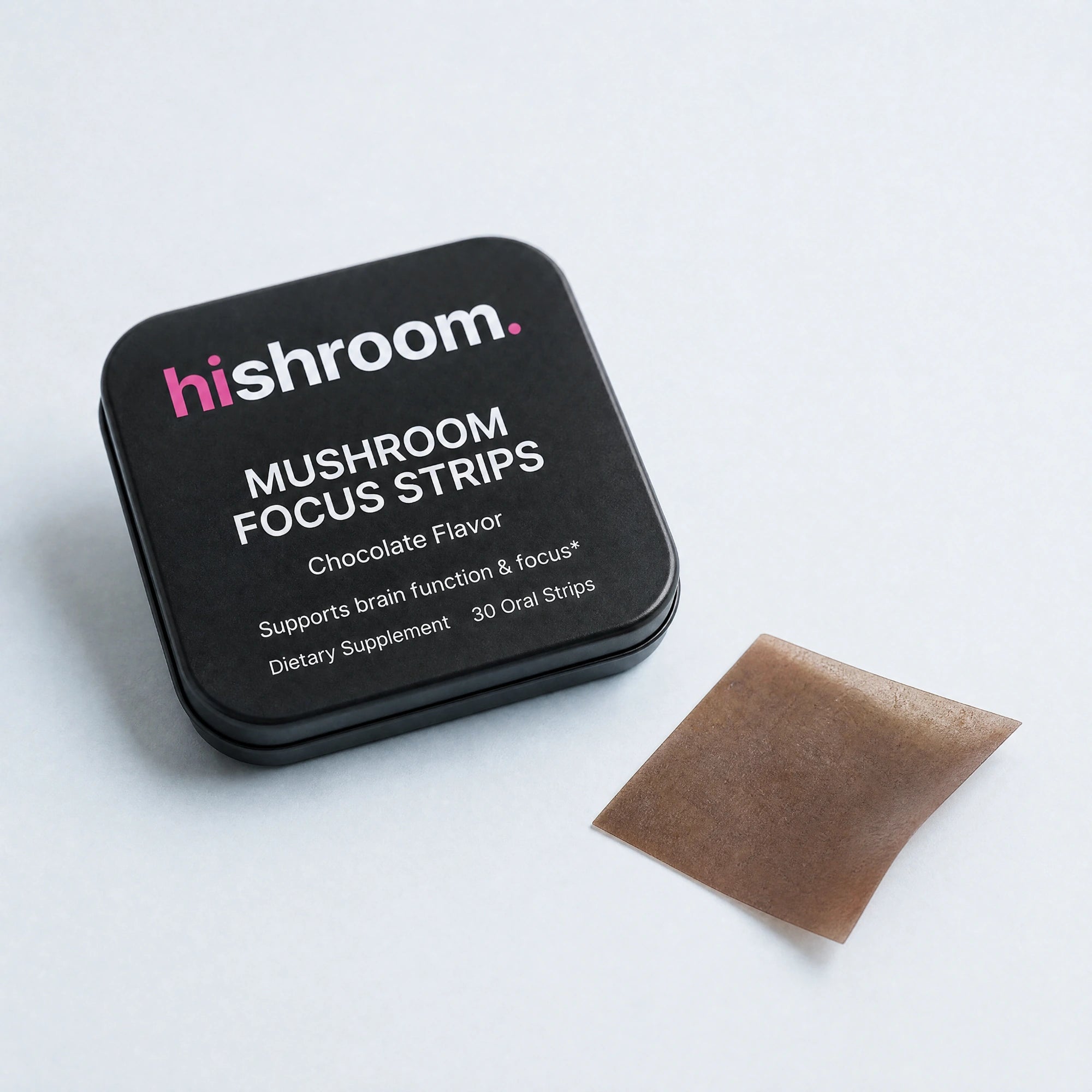
If mixing a powder or swallowing capsules puts you off, this gives you another way to take a mushroom supplement.
There is a practical difference between a product you need to prepare and one that is already portioned. With a strip, the serving is set before you open the tin. You do not need to find a spoon, decide whether a scoop is level or rinse a shaker afterward.
The chocolate flavour is part of that experience. Some customers describe looking forward to it, while others mainly value the lack of mixing. Taste is personal, of course. The point is that you can decide whether this way of taking a supplement suits you, without building your morning around it.
Turn the tin over. You should be able to see the mushroom ingredients and the amount of each in a serving.
HiShroom lists those amounts individually. Its serving is one strip, with 30 strips in a tin, so there is no scoop to measure or blend to divide yourself.
The 260 mg strip weight includes the film and flavour ingredients. It should not be confused with the amount of mushrooms in the formula.
If you take medication or have a health condition, show the label to your healthcare professional before adding it.
The four mushroom names are not four separate products you have to organise. They are included together in each strip. That makes the serving convenient, but the amounts still deserve a proper look. Compare products by what is listed per serving, rather than by the total weight printed somewhere on the package.
Keep the distinction in mind when comparing a tin with a bag of powder. The number of servings, the serving size and the mushroom amounts may all differ. A larger container can contain more servings without delivering more of a particular ingredient in each one. Taking a moment to read those details is more useful than choosing by package size alone.
Dr. Richard Walsh
Neurology
A product description is most useful when it tells you exactly what you will be taking.
For HiShroom, that means four named mushrooms, individual amounts and a one-strip serving. There is no need to infer the serving from the size of the tin.
Keep the label available when discussing supplements with your clinician, particularly if concentration problems are new or getting worse.
The directions are simple: one strip daily.
Remove a strip with clean, dry hands. Place it on your tongue and let it dissolve before swallowing.
No mixing, measuring or glass of water is needed.
Choose a familiar point in your day, such as getting ready in the morning, so the routine has a consistent cue.

Store the closed tin in a cool, dry place and keep it out of children’s reach. Do not use a product with a damaged seal. Follow the label rather than increasing the serving to chase a faster result.
If you keep the tin with your morning essentials, leave it closed between uses. Dry hands make it easier to handle the film. You do not need to cut the strip into smaller pieces or add it to food; use it according to the directions supplied with the product.
For questions about the serving or suitability, use the label rather than instructions for a different mushroom product. The fact that another supplement uses several capsules or a scoop of powder does not tell you how many of these strips to take.
Different formats suit different people. This comparison focuses on preparation and use, so you can see how a strip fits into the day.
 | |||
|---|---|---|---|
| Feature | HiShroom strips | Conventional capsules | Mix-in powders |
| Ready-made serving | ✓ | Count label serving | Measure label serving |
| No water needed | ✓ | Usually taken with water | Usually mixed |
| No mixing or measuring | ✓ | ✓ | Requires mixing |
| No capsule to swallow | ✓ | Capsule format | ✓ |
| Caffeine-free formula | ✓ | Check label | Check label |
| Chocolate flavour | Chocolate | Varies | Varies |
| Mushroom amount per serving | 100 mg | Varies | Varies |
A format comparison, not a comparison of clinical effectiveness.

The difference here is in the preparation: open the tin, take a strip and put the tin away. No extra equipment to wash up afterward.
It can be frustrating to put down a book because you have read the same page twice. Or to lose the thread of a story just as someone reaches the good part.
These are ordinary moments, which is why changes in them can be so noticeable.
You may start making extra notes or going back to check something you have already done.
If that is becoming familiar, explain the change to your healthcare professional.
While you look into it, avoid turning each day into a test of whether a supplement has “worked.” Keep track of symptoms without putting pressure on yourself to feel a particular result.
Choosing a mushroom supplement can be a separate, practical decision. Read its label and decide whether the serving suits you.
HiShroom comes ready to use. There is no mixing, and the small tin is easy to keep with the things you reach for each morning.
You can choose a familiar cue, such as getting ready to leave the house, rather than adding another reminder to your phone.
A supplement should fit around your life. Persistent symptoms still deserve attention in their own right.

It is tempting to judge a whole day by its most frustrating moment. You forget one name and overlook the conversation you followed perfectly well beforehand. Keeping a brief note of the pattern gives you something more useful than that immediate impression. It can also make your next appointment easier.
You do not have to tell yourself that everything is fine, and you do not have to assume the worst. Describe what is happening in plain terms. If you have begun avoiding a favourite activity because concentration feels difficult, include that detail. It explains the effect on your life better than a score you have given yourself.
When you read someone else’s review below, remember that you are hearing about their experience. You may value the same practical details, such as the flavour or the small tin, without expecting your health experience to match theirs.
So what would you be ordering?
Each HiShroom tin holds 30 chocolate-flavoured strips. At the label serving of one a day, that is a 30-day supply.
Choose one tin to start, or a larger bundle for a lower price per tin. The serving stays the same whichever quantity you buy.
Here is how customers describe the taste and the day-to-day experience:
Gregory B.
“HiShroom strips appear to be the first thing I've managed to take every single day. No pills to swallow, no glass of water needed. One just melts on my tongue, so I actually remember to take it.”
Diane Z.
“I love my HiShroom strips! One melts on my tongue after lunch and tastes like rich chocolate with a little hint of coffee. It's become the part of my day I look forward to. There's only the one flavour, but honestly, I don't need another. Give it a try!”
Rocio W.
“I've been enjoying my HiShroom strips for a few weeks and I genuinely look forward to them. I take one each morning with my first cup of tea, before I head out for my walk with the grandchildren. The chocolate taste with that hint of coffee is lovely. I did a lot of research before buying, and I'm glad I made this choice. It's the one routine I haven't dropped.”
Customer comments supplied for this page. Individual experiences are not clinical evidence.
A tin on the counter is easier to remember than a bottle at the back of a cupboard. Pick somewhere cool and dry that you use regularly, and keep it out of children’s reach.
Follow the one-strip daily serving. Taking extra strips does not recreate the preparation used in a study.
When it is time to reorder, the bundle choices below make the cost clear.
Save up to 53% off with the six-tin bundle. Every option is backed by HiShroom’s 365-Day Money-Back Guarantee.
The single tin is $39.99. The three-tin option is $104.99 in total, with a displayed per-tin price of $35.00. The six-tin option is $162.99 in total, or $27.17 per tin when rounded. Compare the total as well as the unit price before choosing.
A larger bundle changes how many strips you receive and what you pay per tin. It does not change the directions or promise a faster result. Choose the quantity that makes sense for you. The same 365-day money-back guarantee applies to each option.
Our lowest price per tin is in the 6-tin bundle.
Your HiShroom purchase is backed by a 365-Day Money-Back Guarantee.
That gives you a full year to try the strips and decide whether they are right for you.
If you are not satisfied, contact info.hishroom@gmail.com with your order number for help with your money-back request.
You can order with the reassurance of a full year’s guarantee.
Keep your order confirmation so you have the order number available if you need assistance. You can contact the HiShroom team by email with a question about your purchase or the guarantee. Include the name used for the order and explain what you need help with, so the team can locate it.
What HiShroom customers have shared about their experience.
James M.
“I was sceptical about another supplement, but I've kept the HiShroom strips on my kitchen counter and taken one with my morning tea for six weeks now. They taste like chocolate, and it's the first routine I've actually stuck with. I've already reordered.”
Margaret Collins
“I’ve taken HiShroom strips for thirty days, and I can really notice a difference in my focus.”
Diane Mitchell
“I used to drift off and lose track of things. Now, it’s much easier to stay focused.”
Susan Whitmore
“It’s easy to keep up with. One strip dissolves on my tongue, and the tin fits in my bag.”
Gregory B.
“HiShroom strips appear to be the first thing I've managed to take every single day. No pills to swallow, no glass of water needed. One just melts on my tongue, so I actually remember to take it.”
Customer experiences vary. These comments do not establish typical results.
Dr. Richard Walsh · Neurology. The doctor attribution shown in this editorial layout has not been represented as an approved product endorsement.
HiShroom makes chocolate-flavoured mushroom strips in a compact tin. Each serving combines Lion’s Mane, Cordyceps, Maitake and Shiitake in a film that dissolves on the tongue.
The product page includes the full ingredient list, directions and bundle options. Customer support is available at info.hishroom@gmail.com for questions about an order.
Medical illustrations are educational. Lifestyle images do not depict treatment outcomes or identify the customers quoted.