“No pills to swallow”
Gregory B.
“HiShroom strips appear to be the first thing I've managed to take every single day. No pills to swallow, no glass of water needed. One just melts on my tongue, so I actually remember to take it.”
A Neurology Perspective On Memory Slips:
A familiar name. The keys you just put down. What you came into the room to do. When small details keep slipping away, start with the pattern, then look at the daily support you choose.


Dr. Richard Walsh
Neurology
If you have started checking the calendar twice, retracing your steps for your keys, or waiting for a familiar name to come back, the question is understandable: why do these little things keep slipping away?
Have you ever walked into a room with a clear purpose, then stopped because the purpose had vanished?
You stand there for a moment. Look around. Go back to where you started. Sometimes the thought comes back as soon as you retrace your steps.
Or perhaps it happens in conversation. You know the person. You know the story. But one detail stays just out of reach while everyone else carries on talking.
The moment may be brief. The second-guessing can last much longer.
It is easy to turn it into a private criticism: I should have remembered that. I was only told yesterday. Why do I need another note?
I want to start with a more useful distinction. Noticing a memory slip, understanding its cause, and deciding whether to use a supplement are three different things.
A forgotten name does not tell you which ingredient to buy. A supplement label cannot explain why you have started missing appointments.
But a closer look at the actual pattern can help you decide what to do next.
The frustrating part is often the interruption. A conversation pauses while you search for a word. A simple trip upstairs turns into a return journey downstairs. The rest of the day keeps moving while you try to recover the detail.
Start there, with the event you can describe. That is more useful than deciding that one lapse tells the whole story about your memory.
WHEN A SMALL DETAIL SLIPS AWAY
What happened?
When did it happen?
Did it interrupt your day?

Illustrative everyday moments, not a progression of disease or a treatment comparison.
Occasional forgetfulness can happen with age. Memory problems can also be associated with factors such as poor sleep, stress, or medicines. A clinician can help investigate the cause.1
If changes persist, worsen, or interfere with everyday activities, arrange a medical assessment. Sudden confusion needs urgent medical attention.
For the everyday pattern, be specific. Was it a name, an item you put down, a plan for later, or the purpose of a task? When did you notice it?
That kind of description is more useful than simply saying your memory is bad. It gives you something concrete to discuss.
And it leaves room for a separate, practical question: if you choose a supplement, how can you make that routine easy to follow?
It can help to bring someone who has noticed the same changes to an appointment. Their examples may fill in details you have missed. You can also bring a list of the medicines and supplements you take.
The point is to make the conversation specific. What changed? When did it start? Is it making ordinary tasks harder? Those questions deserve attention before a purchase decision.
A calendar can hold an appointment. A note can hold a shopping list. A bowl by the door can give your keys a familiar place.
Those are useful tools. But they do not answer every question you have about the moments that prompted them.
Perhaps you are checking whether you already made a phone call. Perhaps you are returning to the kitchen to see what you meant to bring back.
The issue is not the piece of paper. It is the feeling of having to reconstruct something that seemed obvious only moments ago.
Keep the reminders that help. Look more closely at the changes that concern you.
The same practical thinking applies when you consider a new daily product. A routine with measuring, mixing, and several instructions can add another small task to manage.
Before buying, ask what the serving actually involves and whether it fits the way you already organize your day.
A reminder works best when you know where to look for it. Three different notebooks, loose notes and a phone calendar can mean checking several places for one plan. A single place to record an appointment may feel easier to manage.
You do not have to abandon a system that already works for you. Consider the steps that cause friction: the part you put off, the instruction you keep having to find, or the item that never seems to be where you left it.
First, the pattern itself and any need for professional advice. Then, the everyday choices you want to make around your wellbeing.
Within the supplement conversation, one mushroom often draws particular attention: Lion’s Mane.
You may have seen its name on capsules, powders, or drinks. To understand what it means on a label, it helps to separate the mushroom from the specific product that contains it.
An ingredient can be interesting without every formula containing it having the same evidence.
There are three concrete details to compare: the preparation researchers used, the daily amount, and the people they studied.
For Lion’s Mane, those details matter just as much as the name on the package.
A study of one preparation is a starting point for understanding an ingredient. It is not a result that can automatically be transferred to a different serving or format.
A study summary may leave out details that matter to a buying decision. For example, a result after several months is not evidence of an immediate effect. An ingredient tested on its own is different from a blend.
Look for those details in the research itself. Then put the label alongside it. If the preparation and amount differ, keep that difference visible when you weigh the claim.
Lion’s Mane is the common name for Hericium erinaceus. Its cascading white spines make it easy to recognize.
It is a mushroom, not a nutrient that your body must replace because a name or appointment slipped your mind.
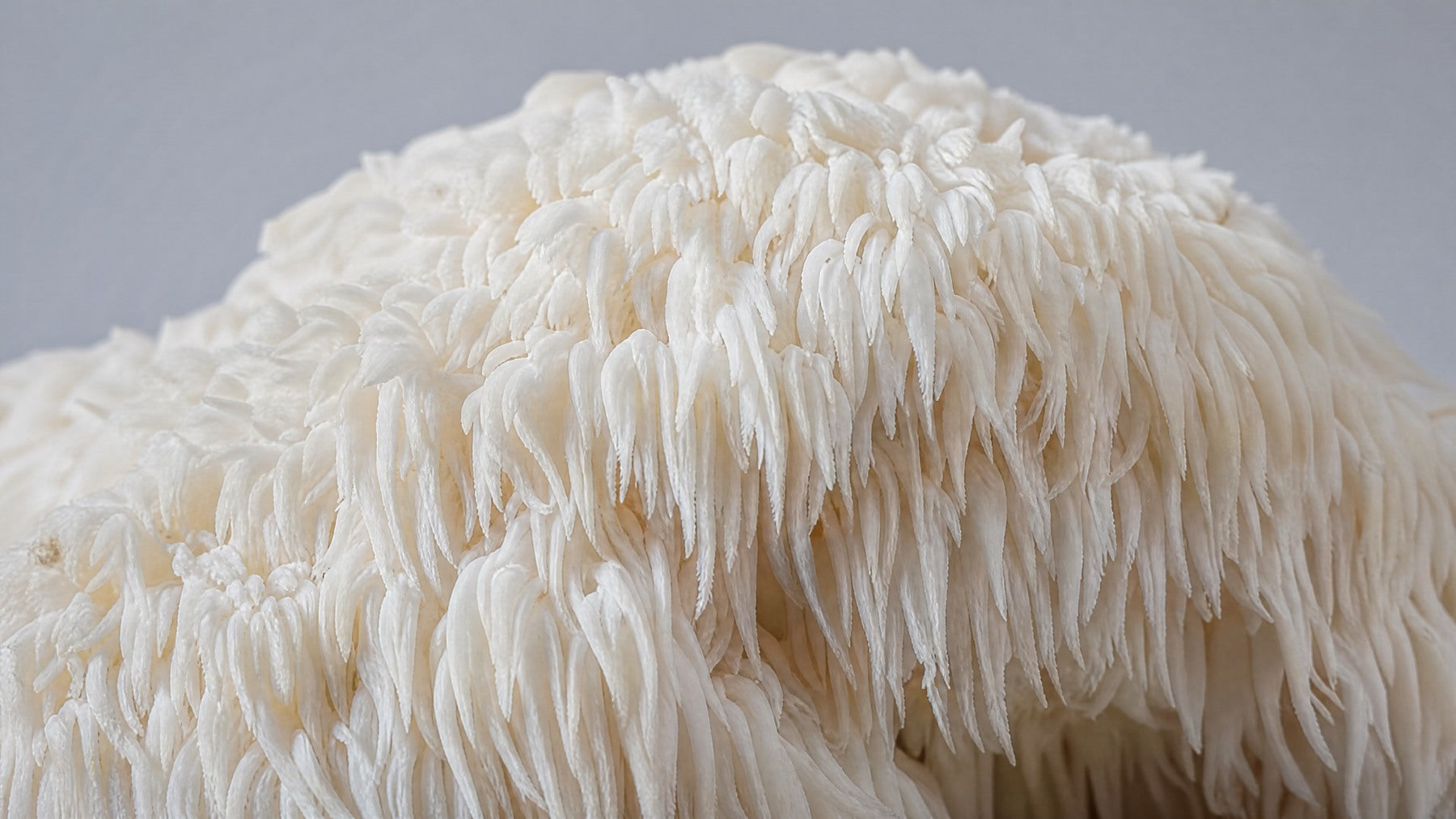
A small placebo-controlled trial published in 2009 studied 30 adults aged 50–80 with mild cognitive impairment over 16 weeks. It reported improvements on a cognitive scale for the studied Lion’s Mane preparation.2
The preparation supplied approximately 2.88 grams of Lion’s Mane powder daily. That is different from the 30 mg listed in a HiShroom strip.
This was ingredient research, not a clinical trial of HiShroom. It does not establish that these strips prevent memory slips or produce the same outcome.
So, when comparing products, read both the name and the amount. Both belong in the decision.
Participants in the 2009 Lion’s Mane study
Thirty people can provide an early signal worth investigating. They cannot represent every person who occasionally loses a name or misplaces a set of keys. The chart shows the size of this particular trial, so you can see the scale of the evidence being discussed.
If you decide a mushroom supplement suits you, the serving should be straightforward.
You should be able to see what is inside, how much to take, and where it fits into your day.
That is where the format becomes a practical part of the choice.
Think about the morning you actually have. You may be getting ready for a walk, making breakfast or checking the day’s appointments. A product that takes several extra steps has to fit into that existing routine.
A prepared serving changes the practical task. Instead of measuring a powder or mixing a drink, you follow one set of directions for the strip. That is the convenience being described here.

Ingredient and product comparison. These are not before-and-after images or measured HiShroom results.
The distinction is easy to miss when both descriptions contain the same mushroom name. Here you can see the ingredient, the study period, the finished formula and the strip separately. The published trial belongs to the preparation it tested. The product label tells you what is actually in the tin you are considering.
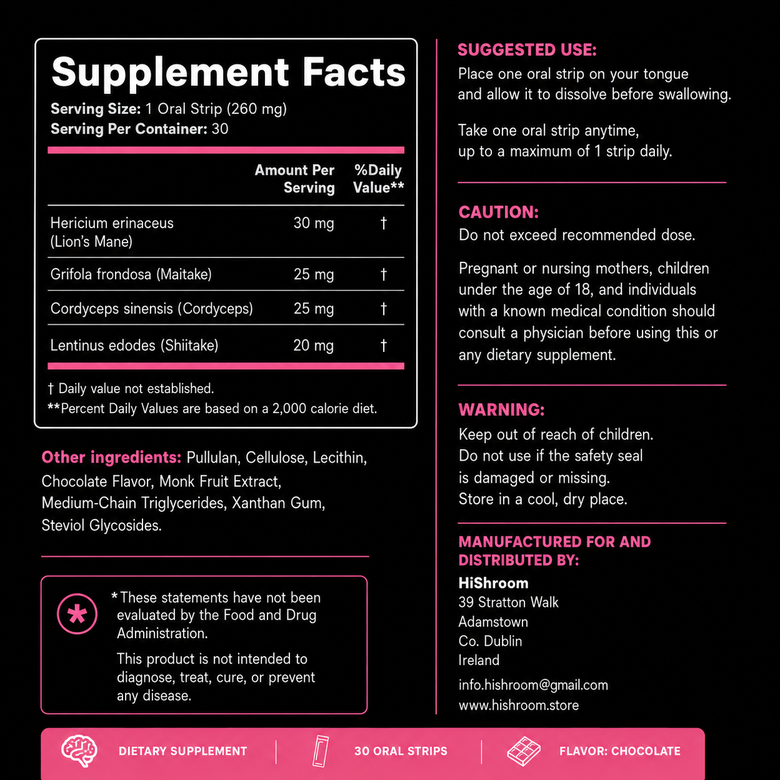
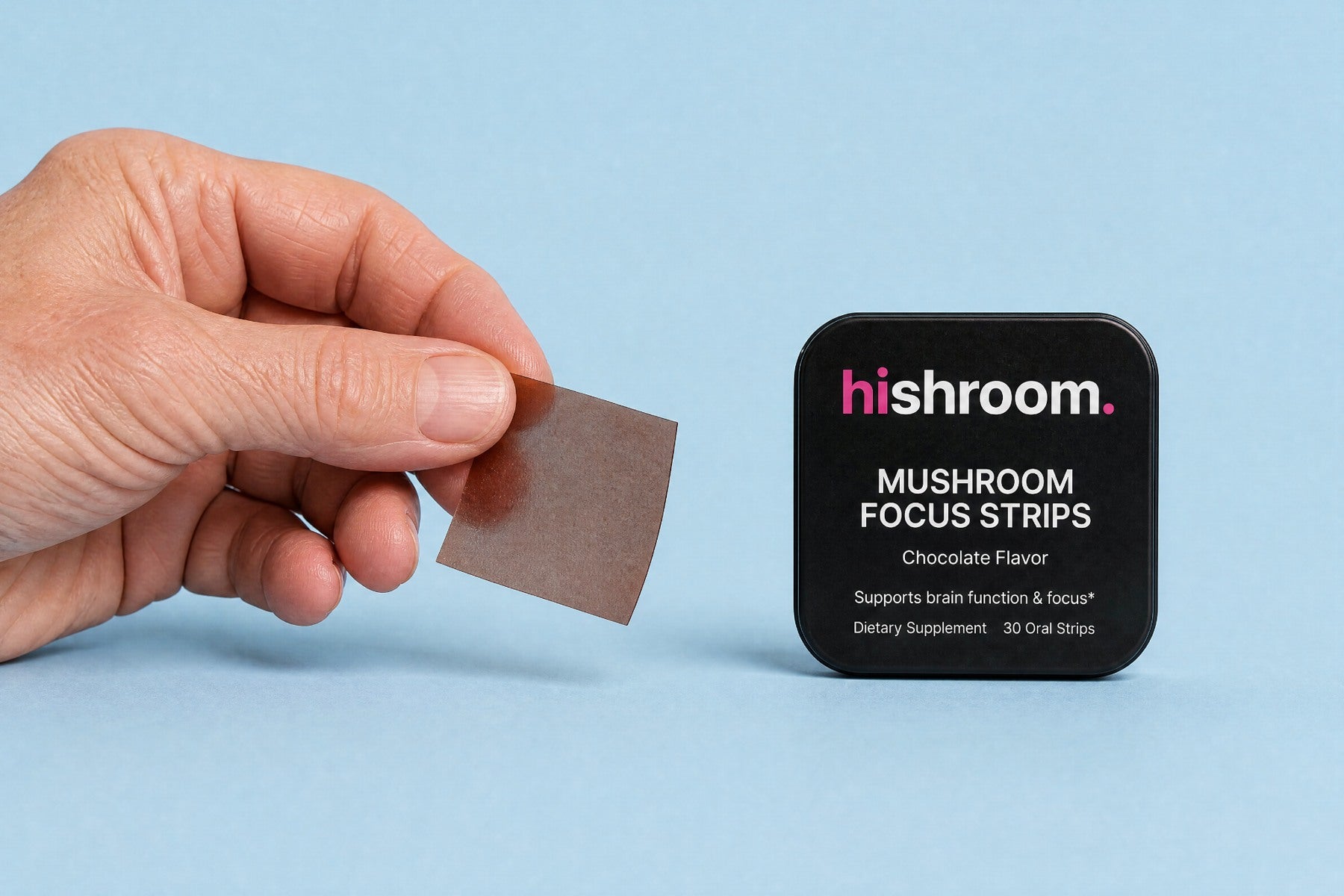
HiShroom combines Lion’s Mane, Maitake, Cordyceps, and Shiitake in a thin, chocolate-flavored strip.
Each tin contains 30 oral strips. The label directs you to place one on your tongue and allow it to dissolve before swallowing, up to a maximum of one strip daily.
The individual amounts are shown openly: Lion’s Mane 30 mg, Maitake 25 mg, Cordyceps 25 mg, and Shiitake 20 mg.
That is 100 mg of mushroom ingredients in a complete 260 mg strip, including the film and other ingredients.
The complete label: mushroom amounts, serving directions and cautions.
You do not need to remember the right scoop size, find a shaker, or prepare a separate drink.
Take the directed strip, place it on your tongue, and allow it to dissolve. That is the serving.
The small tin keeps the strips together, so the routine is contained in one place.
For someone who prefers fewer preparation steps, that simplicity is the reason to look at the format.
365-day money-back guarantee. Contact info.hishroom@gmail.com with your order number to request a refund. See the refund policy for details.
When you are away from home, the same directions apply. The small container changes what you need to carry; it does not change the amount you should take.
A label should help you make a clear decision before the product becomes part of your day.
Read the individual ingredients and the cautions as well as the front of the tin. Follow the directions for the product you actually have.
The number of milligrams in the entire strip is not the same as the amount of mushrooms it contains. The film and flavor ingredients are part of the total weight.
If you take medicines or have a health condition, ask a qualified healthcare professional about suitability and bring the complete label.
There are two different numbers on this label: the weight of the finished film and the amount of mushroom ingredients. Comparing one product’s total film weight with another product’s mushroom amount would give the wrong impression.
Use like-for-like details instead: the named ingredient, its amount per serving and the stated serving size. Those are useful questions to bring to the store if something is unclear.
Dr. Richard Walsh
Neurology
When you describe a memory concern, start with a specific example. A familiar name that comes back later is a different account from an appointment you never recalled making.
For a supplement, be equally specific. The formula, serving directions, and research each provide different information.
My aim in this report is to keep those decisions clear, so a manageable routine does not become a substitute for understanding a concerning change.
One strip. On your tongue. Let it dissolve.
Use clean, dry hands to remove a strip. Let it dissolve before swallowing, following the label’s maximum of one strip daily.
There is no measuring or mixing. A familiar point in the day can serve as your reminder.
Store the tin in a cool, dry place, away from children. Do not use it if the safety seal is damaged or missing.
A supplement format is a preference you can compare directly. Here is how the everyday preparation differs.


| Features | HiShroom oral strips | Typical capsules | Typical powder |
|---|---|---|---|
| A prepared serving with no measuring | ✓ | ✓ | — |
| No powder to mix | ✓ | ✓ | — |
| Taken without a separate drink | ✓ | — | — |
| Dissolves on the tongue | ✓ | — | — |
| Chocolate flavor in this formula | ✓ | — | — |
| A tin holding 30 daily servings | ✓ | — | — |
| Four named mushrooms, with amounts listed | ✓ | — | — |
✓ indicates a stated feature of HiShroom or the typical format. A dash means the feature is not established here; other products vary. Check the label of any capsule or powder you are considering.
This table compares the serving experience. It does not compare memory outcomes, absorption or clinical effectiveness. Flavor, ingredient amounts and package contents depend on the individual product.
The useful difference is practical. You can decide whether the strip is a format you would prefer before making it a habit.
The name you wanted to remember.
The call you meant to make.
The one thing you went upstairs to collect.
Small memory slips can take up more attention than their size suggests. You may find yourself checking, retracing, or asking again.
A daily supplement should be a decision you understand, not another elaborate task to reconstruct.
HiShroom offers a ready-made serving for people who choose to include a mushroom supplement in their routine.

There is a difference between choosing a convenient product and expecting it to organize the whole day for you. Keep using the calendar, the notes and the familiar places that help you find what you need.
There is room for a simple routine alongside those habits. There is also room to ask for advice when a change in memory worries you. One decision should not crowd out the other.
So what does choosing a supply involve?
At the directed maximum of one strip daily, one tin contains 30 daily servings. Three tins contain 90.
Choose the quantity that fits your plans and budget. The number of tins tells you how many servings you are buying, not when you will experience a particular health result.
The product page lists current purchase options and prices.
First, here is how customers describe the routine itself.

Six tins contain 180 strips. At one strip daily, the quantities are straightforward to compare: 30, 90 or 180 daily servings. They describe the contents of an order, rather than a promised timetable for memory improvement.
The offer below shows both the total and the price per tin. Check both numbers so you know exactly what you are choosing.
Gregory B.
“HiShroom strips appear to be the first thing I've managed to take every single day. No pills to swallow, no glass of water needed. One just melts on my tongue, so I actually remember to take it.”
Diane Z.
“I love my HiShroom strips! One melts on my tongue after lunch and tastes like rich chocolate with a little hint of coffee. It's become the part of my day I look forward to. There's only the one flavour, but honestly, I don't need another. Give it a try!”
Rocio W.
“I've been enjoying my HiShroom strips for a few weeks and I genuinely look forward to them. I take one each morning with my first cup of tea, before I head out for my walk with the grandchildren. The chocolate taste with that hint of coffee is lovely. I did a lot of research before buying, and I'm glad I made this choice. It's the one routine I haven't dropped.”
Individual customer experiences. Lifestyle photographs do not identify the reviewers.
A routine can be easier to organize when it has one clear action and one familiar cue.
Some customers describe taking their strip with an established part of the day. The product itself does not require a drink.
Keep the directions in view. The label says a maximum of one strip daily. If you cannot remember taking a serving, do not take an extra strip to catch up.
More strips do not establish better results. The product directions remain the guide.
A place you remember and a serving you understand are simple details to consider before choosing your supply.
A simple check mark can help distinguish “I plan to take it” from “I have taken it.” Choose a cue you already recognize, and use the same place to record the step if that is useful to you.
Keep it uncomplicated. The aim is not to create another long checklist. It is to know what the directions say and whether you have followed them that day.
Check the ingredients, individual amounts, directions, and cautions.
Place one strip on your tongue and let it dissolve before swallowing. Do not exceed one strip daily.
Keep the routine connected to something you already do, with the tin stored as directed.
Choose your HiShroom offer:
Buy 1: $39.99 · 31% off.
Buy 3: $104.99 · 40% off. $35.00 each.
Buy 6: $162.99 · 53% off. $27.17 each.
Each tin contains 30 strips. Every option includes the 365-Day Money-Back Guarantee.
Your HiShroom purchase includes a 365-Day Money-Back Guarantee. That gives you a full year under the guarantee, with the complete terms available when you order.
Keep your order confirmation and read the terms before completing checkout. If you need help with your purchase, contact info.hishroom@gmail.com with your order number.
Your chosen quantity does not change the daily serving. The guarantee is a purchase term, not a promise of a particular health result.
Customers describe different parts of their experience, from the taste and portability to changes they have noticed. These are individual accounts.
James M.
“I was sceptical about another supplement, but I've kept the HiShroom strips on my kitchen counter and taken one with my morning tea for six weeks now. They taste like chocolate, and it's the first routine I've actually stuck with. I've already reordered.”
Margaret Collins
“I’ve taken HiShroom strips for thirty days, and I can really notice a difference in my focus.”
Diane Mitchell
“I used to drift off and lose track of things. Now, it’s much easier to stay focused.”
Susan Whitmore
“It’s easy to keep up with. One strip dissolves on my tongue, and the tin fits in my bag.”
Eva R. · Customer account, paraphrased
Eva described forgetting small details and misplacing things at home. Since starting the strips, she said her memory seemed better and she was not forgetting things as easily. She also found the routine easy to keep because the handy tin could go with her.
Maximum daily serving.
In each tin.
Individual amounts on the label.
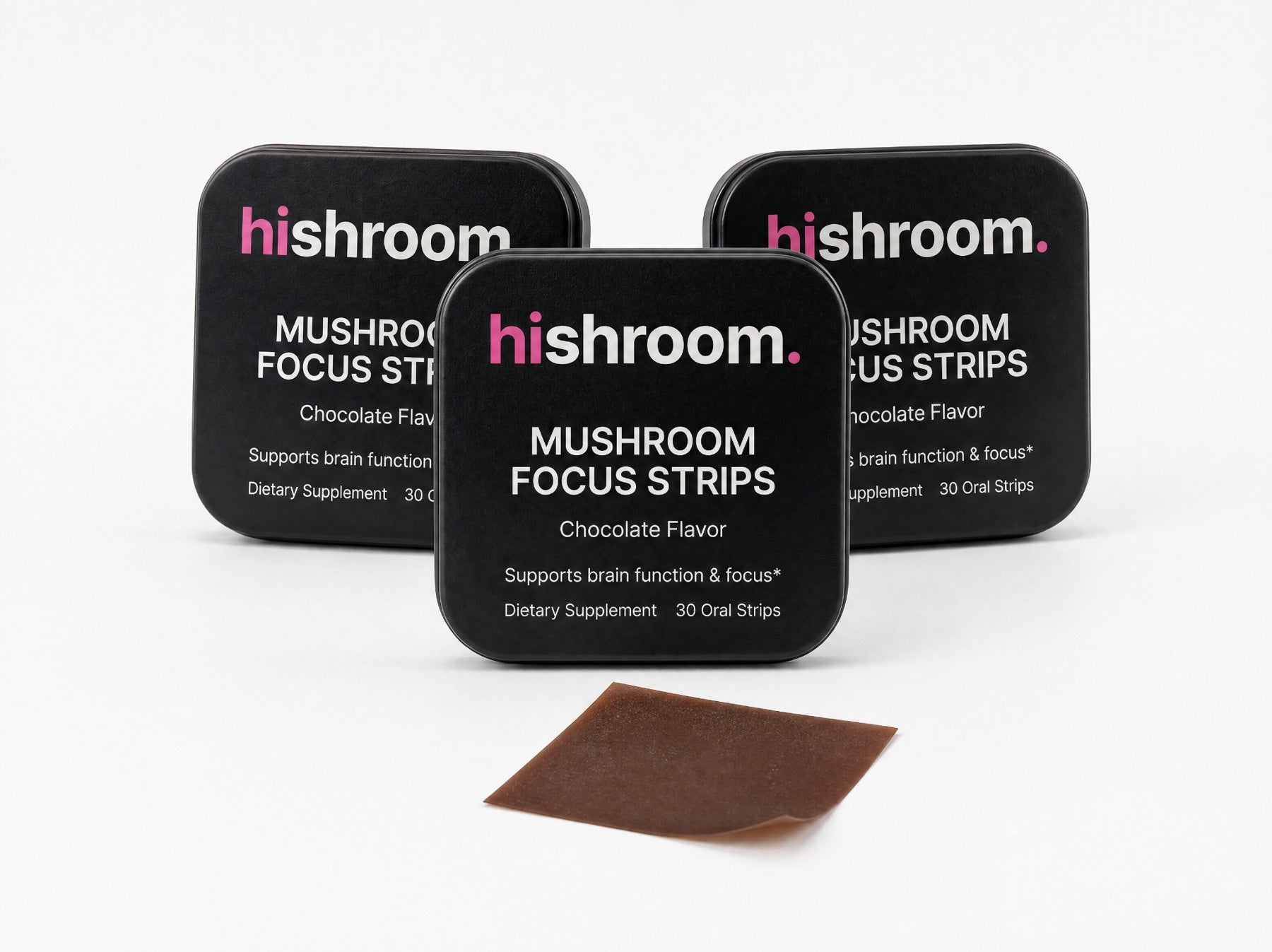
Choose one tin for $39.99, three tins for $104.99, or six tins for $162.99. Compare the total with the quantity you want. Each option includes the 365-Day Money-Back Guarantee.
Our lowest price per tin is in the 6-tin bundle.
Per-tin prices are rounded to the nearest cent. Follow the same one-strip daily serving with every bundle.
Individual experiences vary. These customer accounts do not establish a typical result or a treatment effect.
A missed detail can leave you with a much bigger question. Start by describing what happened, how often it happens, and whether it is affecting your day.
When considering a supplement, make another clear decision: look at its ingredients, its serving, and the practical steps involved.
HiShroom brings four mushrooms into a single oral strip. Read the full label and decide whether that format fits your routine.
Keep the memory concern and the product choice in their proper context. One does not automatically answer the other.
Medical illustrations are educational. Lifestyle photographs do not depict measured treatment outcomes.